Written by Tom Philpott
Tom is senior research associate at the Johns Hopkins Center for a Livable Future, co-host of Unconfined Podcast, and author of Perilous Bounty.
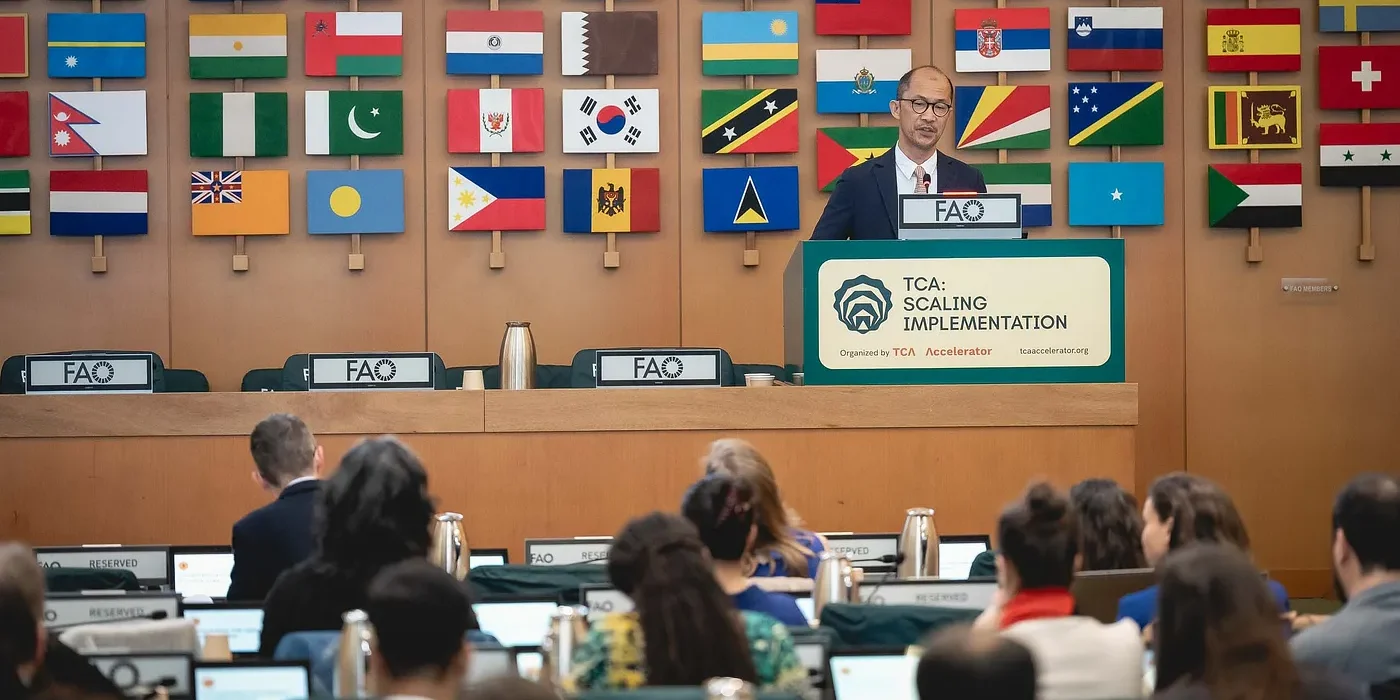
In April 2025, in an auditorium nestled in the austere, labyrinthian halls of the United Nations Food and Agriculture Organization’s headquarters in Rome, a group of 170 researchers, investors, business leaders, advocates, philanthropists, and policymakers, from every continent except Antarctica, gathered for two days in pursuit of an ambitious goal: that the global food system clean up its act — or at least reveal its hidden costs to society — by 2030.
Located at the foot of what remains of ancient Rome’s Circus Maximus, the FAO building made a fitting site for the event, the True Cost Accounting (TCA) Global Summit. The setting drove home that the UN has fully embraced True Cost Accounting as a tool for analyzing the global food system and a roadmap for transforming it. On a metaphorical level, the location — looming over the field where chariot races and other imperial entertainments once took place — nods to the ancient Roman concept of “bread and circuses”: the use of spectacle and cheap food to distract everyday people from thinking too hard about the true problems afflicting the polity. In a sense, across much of the globe, a bread-and-circuses food system prevails: an abundance of low-quality, calorie-dense food engineered for palatability and profit, often marketed by clowns, wrung from the earth at steep environmental and social cost.
That paradigm must change, argued Jenn Yates, Director of the True Cost Accounting (TCA) Accelerator, who organized the Summit. In her opening address, she noted that policymakers and researchers often assess food systems based on metrics like yield per hectare or gross national product. She posed the event’s core question: “Why do we continue to use such narrow measures of success in food and agriculture, while ignoring many of the critical impacts that are often referred to as hidden costs or externalities — from things like soil degradation, greenhouse gas emissions, public health impacts, nutritional deficiency, and rural livelihoods?”. In addition to waving away damaging externalities, conventional assessments also ignore benefits often delivered by farmers and other food producers, including preservation of biodiversity, water conservation, and community resilience.
Indeed, according to the FAO’s reckoning, the unaccounted for environmental, health, and social costs of agrifood systems stand at more than $12 trillion annually — a staggering sum equal to at least 10 percent of global GDP. Speakers at the event stressed that these damages fester off the balance sheets of the corporate giants that extract the great bulk of profit from the agrifood system; and are instead imposed on actors ranging from underpaid and often mistreated workers; communities burdened by degraded air, water, and soil; and most prominently of all, on the billions of people who rely on the system for sustenance. Fully 70 percent of the food system’s annual unpaid toll manifests in the diet-related chronic health conditions that arise from Big Food’s aggressively marketed and unhealthy products.
In addition to what economists call “negative externalities,” the food system also harbors uncompensated positive outcomes, several speakers including Yates noted. For instance, many farmers employ management-intensive crop and livestock rotations that trap carbon in soil and reduce toxic runoff. But if they can only access markets that don’t fully pay for these public goods, their ability to maintain them — and their ability to convince peers to follow suit — can wither.
What TCA proposes is a move to transparency: that all decision makers, from policy, to business, to food growers and producers, consider the social, public health, and environmental costs — and benefits — of their decisions. In order to hold prices down while maintaining profitability under such a framework, corporations would be pushed to minimize environmental, social, and public-health harms while maximizing the public good; governments would be incentivized to roll out food and farming policy that promotes healthy eating and regenerative farming, not all-out production of a few commodities that serve as the building blocks for health-ruining ultra-processed foods; and consumers would be nudged to make healthier, more environmentally robust choices.
The first day of the TCA Global Summit centered on “Lightning Talks” — reports from six virtual workshops convened in the preceding months by the TCA Accelerator to review TCA efforts to date, as well as identify the barriers and solutions to broader TCA implementation. The workshop themes included Global Policy and Action; Private Sector Implementation; Finance and Investment; TCA Evaluation; Communications and Advocacy; and Aligning Forces. Discussion across these workshops tended toward common themes. Multiple groups named the entrenched status quo interests of the incumbent agrifood industry — which has invested a portion of its mammoth annual profits into political power through lobbying and consumer appeal through advertising — as a major obstacle. Relatedly, most of the reporting groups lamented greenwashing and “zombie narratives” focused on scarcity and perceived efficiency — basically, industry-funded efforts to frame the status quo as the best of all possible worlds.
Multiple speakers mentioned the need to place affected communities at the center of the effort to drive TCA implementation forward. I, a US-based journalist and researcher at the Johns Hopkins Center for a Livable Future and a member of the Communications and Advocacy group, argued for a “nothing about us without us” approach to communicating costs imposed on people who most directly bear the food system’s hidden costs: farm workers, meatpacking workers, neighbors of polluting farm-animal facilities, to name a few. As an example of a successful project using TCA principles, I noted the U.S.-based “Fair Food Program,” a migrant worker-led initiative to improve pay and working conditions that began among ruthlessly exploited tomato pickers in Florida and has since spread to other regions where similar dynamics prevail.
Speaking for the Aligning Forces group, Oliver Oliveros, Rome-based Executive Coordinator of the Agroecology Coalition, stressed the crucial role of social movements, particularly in the Global South, for just and fair scaling of TCA. He also made the case that social movements should embrace TCA as a tool to help “question the status quo, bring policy-level changes, and bring the voices of the marginalized to the forefront.”
Kelly van Heyningen, who attended as a PhD candidate studying food sustainability at Erasmus College in Amsterdam, called the Lightning Talks the “most interesting moment” of the event. “While each community focused on their own industry or type of action, very similar challenges came up regarding scaling TCA,” she observed. She added: “we need to focus on these dilemmas,” such as the stubborn political-economic power of the incumbent agrifood industries and the zombie narratives they propagate.
Next came two highly productive hour-long breakout sessions, wherein each stakeholder group represented in the Lightning Talks gathered with colleagues to informally discuss dilemmas and chart paths forward. One interesting idea that emerged from the Communications and Advocacy group: a global “rapid response team” of communications specialists that can mobilize when major media come out with widely circulated articles that position the status quo food system as the best one possible.
During his closing remarks at the end of day one, Salman Hussain, Head of the Economics of Nature Unit at the UN Environment Programme, praised TCA as a tool of analysis for researchers and NGOs, but added a caveat: it cannot scale to a level where it governs corporate accounting, he argued, unless and until advocates can inspire policymakers to see it “as a solution to a problem they have.” His statement amounted to a crucial challenge, because the incumbent agrifood industry has proven adept using its political-economic clout to inspire policymakers not to acknowledge the food system’s gaping hidden costs as the problem.
The next day, conference speakers brought the panel down to earth, to the farm fields that sustain humanity. In a two-person panel called Successful Farmer Collaboration, Janet Maro of Sustainable Agriculture Tanzania and Brooke Gentile of Organic Association of Kentucky (United States) compared notes on farmer-led efforts to improve environmental and social outcomes in their disparate geographies. Phumsith Mahasuweerachai, a behavioral economist at Khon Kaen University in Thailand, presented research demonstrating that non-conventional rice-agriculture techniques, including organic, slashed negative public-health externalities related to growing Thailand’s staple food crop — while in some cases increasing crop yields. Even so, Mahasuweerachai noted, chemical-intensive growing techniques remain dominant. His assessment of what holds back sustainable rice agriculture: that so far, neither government incentives nor private-sector food purveyors have done enough to compensate farmers for making the switch.
Mahasuweerachai’s presentation thus cut to the heart of the challenges facing TCA — and also its promises for moving us toward a robust, abundant food system as climate change accelerates. As Jenn Yates noted in her closing remarks, the issues highlighted by the event’s speakers have festered for decades. She read aloud a passage from Fast Food Nation, a thoroughly reported exposé of the U.S. food system published way back in 2001 by journalist Eric Schlosser, who had addressed conference attendees at dinner the night before: “The low price of a fast-food hamburger does not reflect its real cost, and should. The profits of the fast-food chains have been made possible by losses imposed on the rest of society. The annual cost of obesity alone is now twice as large as the fast food industry’s total revenues.”
Yates stressed that the event marked the beginning of a renewed effort to use such insights as a tool for repairing a global food system characterized by social, environmental and public health degradation. Summit attendee Agathe Crosnier, a PhD candidate at the Swiss Federal Institute of Technology, seemed ready to accept Yates’s challenge. Crosnier left the meeting with a “renewed sense of motivation and community,” she said, adding that “it was truly inspiring to see the work conducted at different levels around the globe, and to engage with peers in TCA methodology grappling with similar questions.” Her Dutch peer van Heyningen, too, was galvanized. She said she left Rome convinced that TCA pointed the way from “‘zombie narratives’ to a regenerative reality.” Her main takeaway, she added, was that “TCA can help de-risk and create value for businesses by helping them better understand the nature and social well-being on which they depend.”
With the Summit as a springboard, the TCA Accelerator will launch a public consultation process for creating an Action Agenda to “dramatically scale TCA by 2030.” Calling on the participation of the assembled, Jenn Yates added: “This is not something that any of us can do alone. The only way we can compel the kind of shift we’re describing to the status quo is by working together and collective action — so we need your commitments and your collaboration, we need your networks, and we need your heart and your time.” At a moment when our need for a food system that restores and nourishes people and the planet has never been more critical, True Cost Accounting has come of age.